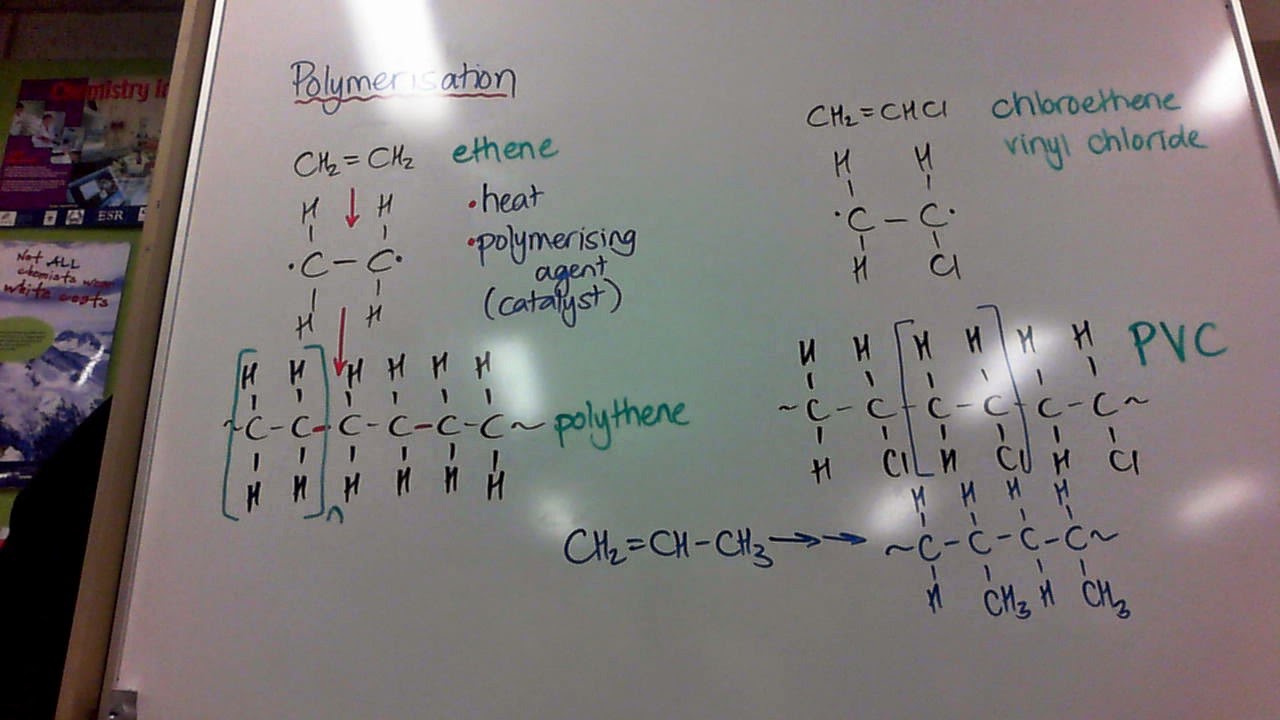
Friday, 16 October 2015
Wednesday, 14 October 2015
Tuesday, 13 October 2015
Tuesday, 15 September 2015
Organic Chemistry Reaction Scheme
This image shows the key relationships between the functional groups we learn about in this topic. Can you fill in the arrows with suitable reagents? Do you know the importance of the green terms? Why is NH2 underlined in amines? Why is the H underlined in carboxylic acids?
Thursday, 10 September 2015
Alcohols - Typical Reactions
In this topic, we will do some experiments with primary, secondary and tertiary alcohols. Here are some videos explaining some of the expected observations and how to use them to identify/classify alcohols.
Alcohols - Preparation from Alkenes
There are a few ways to make alcohols:
- fermentation of sugars
- synthesis gas
- hydration of alkenes
We looked at the hydration of 1-butene using dilute sulfuric acid:
Alcohols - Structure
The structure of alcohols tells us a lot about their physical properties and chemical reactions. Last year, the first lesson was about the different isomers of C4H9OH, with the students starting by trying to make (and name) all of the ones that contain the alcohol functional group. Can you name these?
EXTENSION (not covered in Level 2, but worth seeing if you notice something interesting about the 3D structures of 2-butanol):
Wednesday, 9 September 2015
Haloalkanes
Haloalkanes are a very useful intermediate compound, often used when converting one useful compound into another. Their own uses are limited, primarily due to the impact they have on the environment. Haloalkanes are generally immiscible (insoluble in water) as they are (technically) non-polar.
Haloalkanes are the products of:
- reacting a halogen (such as bromine) with hydrocarbons.
- reacting an alcohol with Lucas Reagent (chloroalkanes produced); remember that tertiary alcohols react very quickly, while primary alcohols may not react at all.
- reacting an alcohol with PCl3, PCl5 or SOCl2
Haloalkanes can be converted into:
- alkenes, using NaOH (or KOH) dissolved in alcohol (elimination reaction)
- alcohols, using aqueous NaOH (or KOH) (substitution reaction)
- amines, using excess NH3 (substitution reaction); if you use do not use enough NH3, it will make an amino salt instead, such as ethyl ammonium chloride
Tuesday, 8 September 2015
Identifying Hydrocarbons
Today, we we challenged to work out what class of hydrocarbons were in bottles labelled only as "A", "W" and "Z". Once we had it correct, we were told which hydrocarbons were in each bottle. Here is one way to present our findings if it was an NCEA question:
Alkenes (2)
Here is an introduction to two of the most simple reactions of alkenes: combustion and addition:
Alkenes (1)
Alkenes are unsaturated hydrocarbons. The functional group is a C=C bond (double bond). This lesson is based around the isomers and nomenclature of alkenes:
Here is an activity that shows alkenes have the same general formula as cyclic alkanes:
Here another activity which is just a little tougher:
Wednesday, 26 August 2015
Introduction to Organic Chemistry - Alkanes
I'm not a fan of teaching this topic the way Beginning Chemistry does. The following blog posts will be how I taught this in 2014. Hopefully this will complement the work being done in class with our student teacher.
I prefer to "get into it" with the functional groups and cover types of reactions, nomenclature and isomerism over and over again, in context. So, we jumped straight into using MolyMods to make as many isomers of C5H12 as possible.
Friday, 14 August 2015
Wednesday, 12 August 2015
Tuesday, 11 August 2015
Revision Lesson: Solid Types
Today we did a brief overview of the one of the topics that will be in an Achievement Standard in our upcoming exam:
pH Overview
Today, I taught Mrs Naseem's class and we did an overview of pH and pH Calculations. Here are the whiteboard notes that I gave them. They may be useful to complement the work we did in class:
Friday, 7 August 2015
pH of Strong Bases
One of the more difficult skills is calculating the pH of a strong base. To do this, we need to know how to find the hydronium ion concentration from the hydroxide ion concentration:
Acids and Bases Videos
Here are some videos of the key concepts being taught in previous years:
2014
2013
2013
2014
2013
2014
2013
2013
2014
Thursday, 6 August 2015
Acids, Bases, Conjugates and Amphiprotic Species
There is a very useful definition of acids and bases worth remembering:
Acids = "proton donors"
Bases = "proton acceptors"
Then, we looked at the pH of some salts and tried to justify the results. For example:
Acids = "proton donors"
Bases = "proton acceptors"
Then, we looked at the pH of some salts and tried to justify the results. For example:
To clarify, ammonium chloride was acidic and sodium ethanoate was alkaline.
Subscribe to:
Posts (Atom)